
The Revenue System for Expert Services Seller-Doers
Traditional sales wasn’t built for expert services. 5RS was.
For firms where delivery is the product and relationships drive revenue, 5RS gives seller-doers a disciplined way to grow without becoming a high-pressure sales operation.
Beta site for the 5 Rs Book, 5RS Revenue System, and upcoming works.
Why this exists
Most sales methodologies were built for salespeople. People whose entire job is to sell. People with pipelines, quotas, CRMs, SDRs, and a clear separation between the work of winning business and the work of doing it.
You are not that person.
You are a marketing researcher, a lawyer, a consultant, an engineer, an advisor, an architect — someone who was hired, promoted, and made partner because of what you know and what you can do. Selling was never supposed to be your whole job. It was supposed to come naturally, through reputation, through relationships, through doing good work. And for a long time, maybe it did.
But at some point the firm needed more from you. Clients needed renewing. New relationships needed building. Revenue targets appeared. And suddenly you were expected to be a seller-doer — to carry a book of business while still delivering the work, managing a team, and maintaining the expertise that made you credible in the first place.
Nobody gave you a system for that. They gave you a CRM you don’t use and sent you to a sales training that felt designed for someone else entirely.
The methodology problem
The traditional sales playbooks — SPIN Selling, Challenger, MEDDIC, solution selling — were engineered for transactional, quota-carrying salespeople operating in discrete sales cycles. They assume a dedicated seller. They assume a prospect who doesn’t already know you. They assume a funnel with clear stages, consistent deal sizes, and a handoff to delivery once the contract is signed.
Expert services doesn’t work that way.
Your relationships don’t fit in a funnel. Your best clients came through a conversation at a conference, a referral from someone you helped three years ago, a former colleague who remembered you when the problem finally got big enough. The “close” isn’t a moment — it’s the accumulation of trust over months or years. And once you win the work, you’re the one doing it, which means every engagement is also a relationship you have to tend, deepen, and eventually convert into the next one.
When seller-doers try to force traditional sales methodology onto this reality, one of two things happens: they abandon the methodology entirely because it doesn’t fit how they actually operate, or they adopt it just enough to feel guilty about not using it properly — logging calls into a CRM they resent, running “discovery” conversations that feel like interrogations, chasing deals on timelines that have nothing to do with how their clients make decisions.
Neither outcome generates revenue. Both create friction, anxiety, and a growing sense that you’re bad at something you should have figured out by now.
The deeper problem — the seller-doer identity
There’s something more personal underneath the methodology problem.
Most expert services professionals didn’t get into their field to sell. They got into it to solve hard problems, to advise, to build, to consult. The identity of “salesperson” feels foreign — sometimes even uncomfortable. It carries connotations that conflict with the expert identity: pushy, self-promotional, transactional, relationship-as-instrument.
So seller-doers underinvest in business development. They wait for inbound. They rely on referrals they never ask for. They avoid follow-up because it feels like pestering. They underprice because the conversation about money feels unseemly. They let strong relationships go dormant because there was always a deadline, always a deliverable, always someone else’s urgency competing for the same hours.
And when revenue slows — when the pipeline thins or a key client relationship fades — the instinct is to blame capacity, not capability. I just don’t have time to sell. But the real issue is structural: there’s no system, no rhythm, no methodology that fits the actual shape of how expert services business develops.
What are the 5 Rs?
Five dimensions. One operating system.
Every account and every project can be read through five lenses. Together, they turn relationship-driven selling into something you can measure, coach, and repeat.
-
R1
Relationship
The trust, access, and influence you hold in an account — from a single contact to a true organizational insider.
-
R2
Rivals & Roadblocks
The competitors you must beat deal by deal, and the structural barriers that decide whether you get a fair shot at the work at all.
-
R3
Requirements
The stated, unstated, and latent criteria a client uses to structure and award work — and your ability to shape them before they solidify.
-
R4
ROI
The client’s perception of value versus price, and whether that conversation lives with an operator, a manager, or an executive sponsor.
-
R5
Results
How reliably you deliver on time, on budget, and on spec — the proof that everything else in the system was real.
What makes it different
Not another sales framework. A different unit of measure.
Relationship is a graduating metric, not a checkbox.
R1 measures the quality of an account and the influence you carry within it, on a scale that runs from an unknown vendor to a true organizational insider. It gives you a clear answer to “what’s next” that isn’t just “more revenue” — it’s the next level of access and trust to build toward.
Every R splits into Macro and Micro.
Each dimension is tracked at the account level and the individual project level at once. That lets the system weigh overall account health alongside the opportunity in front of you — so a single deal never gets prioritized (or sacrificed) without the full picture.
It functions as stage-gates, not just a scorecard.
Results (R5) earn you Relationship capital (R1); that capital is what buys permission to influence Requirements (R3), and so on through the system. The 5 Rs don’t just describe where an account stands — they define what you’ve earned the right to do next. It’s a playbook, not a report card.
The book
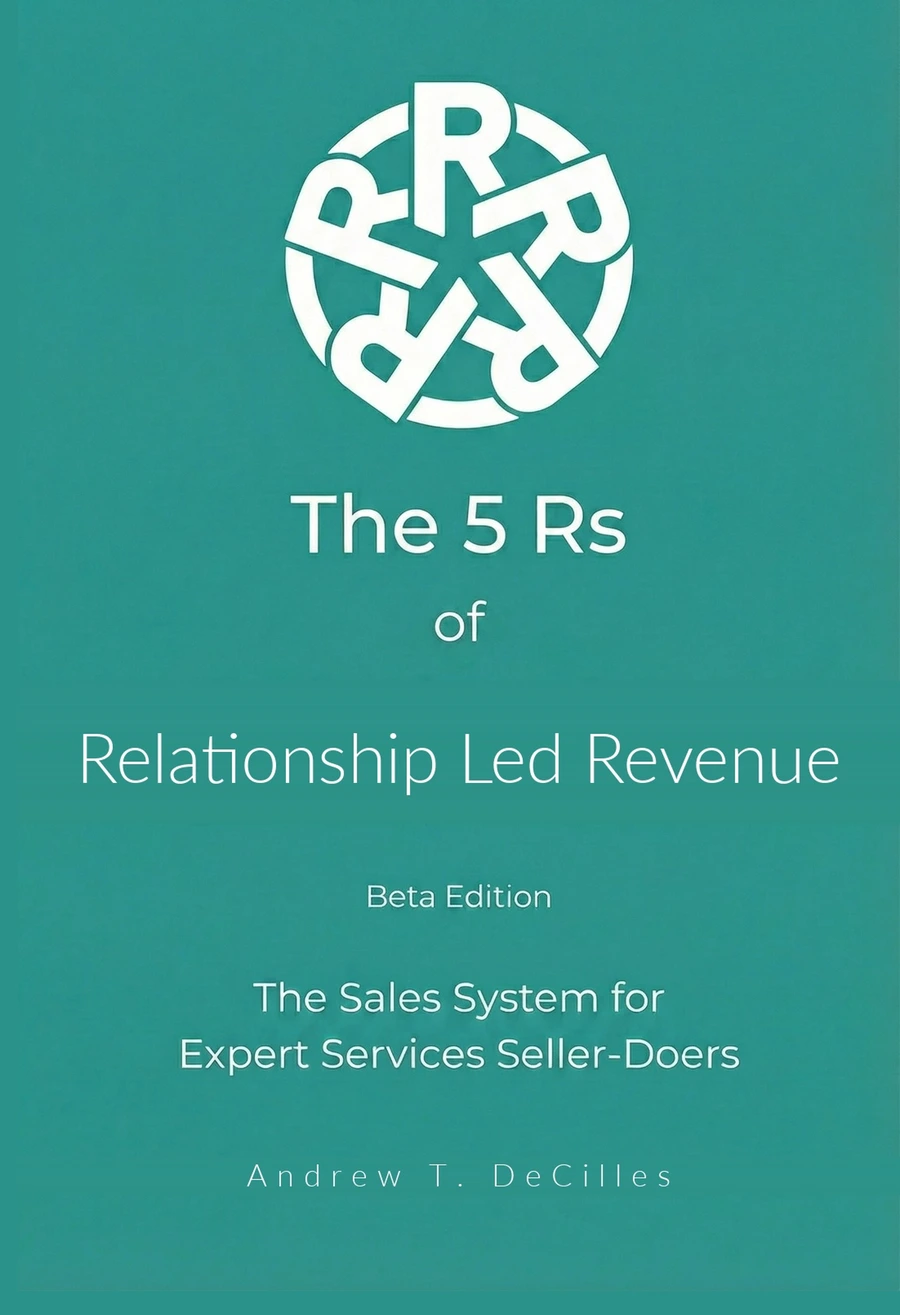
The book: The 5 Rs of Relationship Led Revenue
The 5 Rs book is the first public articulation of the methodology—a field-tested guide for turning trusted relationships into a deliberate revenue system for expert-services firms.
It is written for managing partners, practice leaders, and seller‑doers who want a more reliable growth engine while preserving the integrity of their work, their teams, and their client relationships.
Early beta edition, focused on exposing the principles and frameworks of The 5 Rs.
Advance readers
Advance reader feedback
If you are reading an advance copy, your candid feedback will directly shape how the 5RS methodology evolves for expert-services leaders. The most useful input is where the approach feels clear, where it conflicts with current practice, and where additional field tools would be most useful.
Open feedback formDesigned for managing partners, practice leads, and seller‑doers willing to share grounded, in‑the‑field observations.
What’s Next?
Field guide and founding pilot
A practical field guide and a small founding pilot cohort are in development. The focus will be on helping a handful of firms apply 5RS in live client work—translating the concepts into internal rituals, tools, and measurable revenue outcomes. Subscribe to updates to be the first to know!
Low‑volume, relationship‑led updates only. No generic mailing list or automated nurture sequences.